
As our programme has progressed, the vital role that household income and affordability plays in prosperity and wellbeing has become increasingly evident. For example, while the Grocery Commissioner has found that retail food is slightly (+3% in 2023) more expensive in New Zealand than the OECD average[1], this cannot fully explain why thousands of children and families in the Waikato regularly go without food.
Affordability is high on everybody’s mind right now as the Iran conflict enters its fourth week. While a transition to a lower emission, more abundant energy system is desired by most, the current reality is that fossil fuels are still the dominant source of energy for the world and New Zealand (Figure 1). To date, non-fossil based energy sources tend to add to the overall energy mix, rather than substitute for them. The current track of global crude oil prices will amplify affordability challenges for most people as long as crude prices and shipping risks remain high.
[1] Annual-Grocery-Report-2024-6-August-2025-.pdf
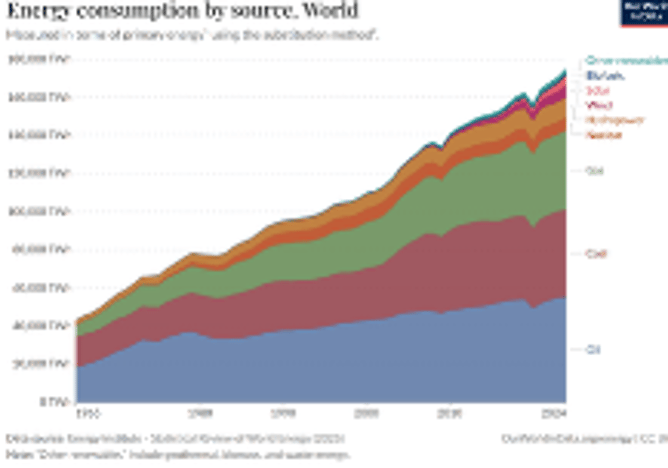

Figure 1. Historical Energy Mix, Global and New Zealand 1965-Present (Our World in Data)
Antecedent conditions, life course stages, social, economic and cultural factors and structural inequities all affect affordability. Differences in income certainly have a fundamental role, as was shown in our Want Amongst Plenty report on food security in the Waikato. As the example from Hamilton below illustrates, differences in household income (either employed, unemployed or on superannuation) along with the number of dependents in a home has a major influence on the adequacy of income for people and families. In this example, the 8 representative households are all assumed to rent a house at the median rent for Hamilton and are receiving the Accommodation Supplement where its available. Figure 2 shows the residual income left after accounting for basic living costs. This shows that the highest weekly residual income is about $400 (2 adults, no kids, both employed), while most other cohorts with a positive balance have less than $200 available. Several cohorts have a negative balance including:
Single adults, no dependents, on New Zealand superannuation, balance of -$110 per week
Two adults, no dependents, on New Zealand superannuation, balance of -$280 per week
Two parents with kids, not employed, balance of -$475 per week
Single parent with kids, not employed, balance of -$95 per week
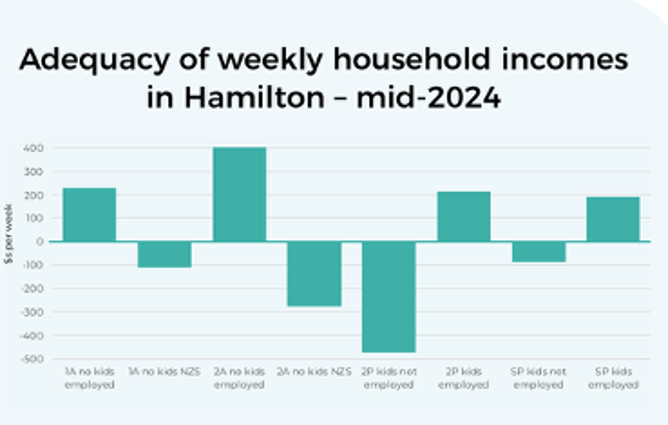
Figure 2. Income Adequacy in Hamilton, 2024
While generalised, the model shows how many common household typologies in Hamilton and the Waikato are experiencing household budget deficits before there are any increases in living costs. For many others, any increases in costs (for example rent, food, fuel or electricity bills) will quickly change their situation from having some additional income each week, to being in deficit. A single event such as a car breakdown or school fees can turn barely getting by, into not having enough for the basics.
The Hierarchy of Household Needs
In 1969, former New Zealand Prime Minster Norm Kirk famously said “…basically, there are four things that matter to people: they have to have somewhere to live, they have to have food to eat, they have to have clothing to wear, and they have to have something to hope for.”
In doing so, Kirk expressed in very human terms, a basic hierarchy of human wellbeing as relevant today, as it was more than 55 years ago. Kirk’s hierarchy is in some ways a simplified expression of Maslow’s hierarchy, with physiological needs at the foundational level, eventually arriving at self-actualisation- “something to hope for”.
Maslow’s hierarchy of needs frames human wellbeing as a progression from foundational survival requirements to higher-order fulfilment (Figure 3). At its base are physiological needs—food, shelter, and clothing—followed by safety and security, including stable housing and income; only when these are reliably met do people have the capacity to prioritise social belonging, esteem, and ultimately self-actualisation.
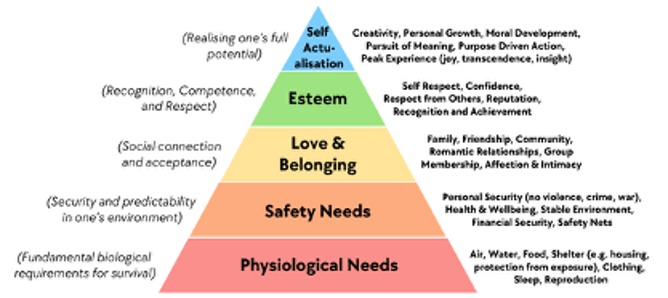
Figure 3. Maslow’s Hierarchy
Within this structure, housing stands out as both a basic physiological need and a cornerstone of security, making it a primary driver of overall wellbeing. Because housing costs are typically unavoidable and inelastic, they shape residual household income and directly influence access to food, health, and social participation. While higher-order goals such as identity, equity, and sustainability remain important, their pursuit is materially constrained when foundational needs—particularly secure and affordable housing—are not met, positioning housing affordability as a critical lever for broader social and economic outcomes.
Our work across some of the key factors affecting household and whanau wellbeing has led us to conclude that housing affordability is the major force multiplier issue for improving not only household affordability but overall prosperity and wellbeing for many people, households and communities in the Waikato.
What Matters to People?
The image beloew shows the most recent results from the regular IPSOS New Zealand Issues Monitor[1]. When asked, the top 5 issues mentioned by New Zealand have been consistent since at least 2019- the cost of living, healthcare, the economy, housing and safety.
[1] Ipsos New Zealand 31st Issues Monitor | Ipsos
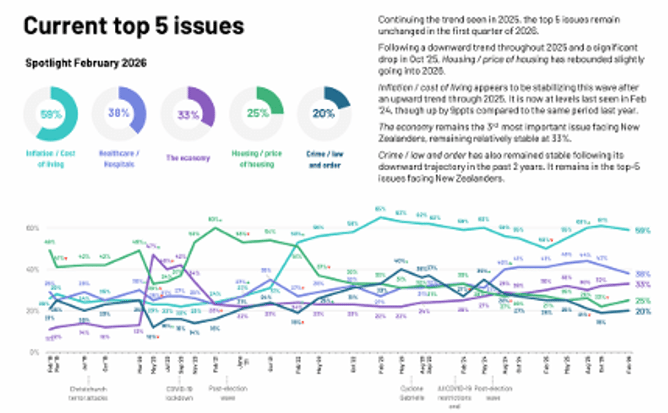
Figure 4. IPSOS Issues Monitor- February 2026
Figure 5 shows data from Household Economic Surveys in 2019 and 2023. It shows that the items which are both most fundamental to household/human wellbeing AND which are identified as being the most important issues to New Zealanders are also amongst the biggest items in the household budget and have experienced the greatest increases in costs over time.
Between 2019 & 2023, average weekly household expenditure increased 18.4%, driven by increases in six spending areas:
housing and household utilities – up 15.5% (to $398 per week)
food – up 28.1% (to $300 per week)
health – up 18.5% (to $50 per week)
transport – up 16.5% (to $252 per week)
miscellaneous goods and services – up 21.6% (to $139 per week)
other expenditure – up 31.4% (to $176 per week)
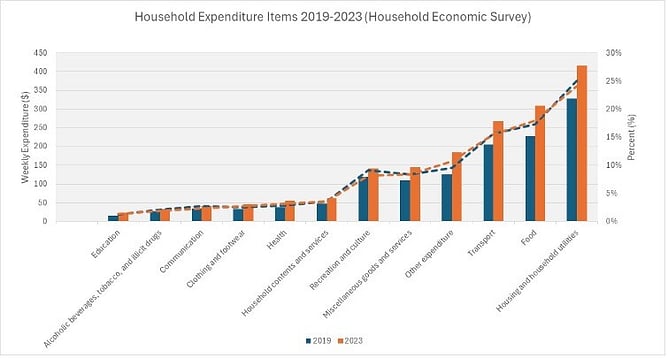
Figure 5. Household Economic Survey New Zealand 2019-2023
From this data and the hierarchy, we have developed a simple household budget schematic (Figure 5) of how affordability, especially of housing, drives other aspects of wellbeing and prosperity.

Figure 6. Household Economic Hierarchy Schematic
The schematic illustrates how price increases for household budget items with low demand elasticity (i.e. how much demand is affected by price) and low deferability, affects overall wellbeing by squeezing the resources available for more elastic/deferrable items. In the above model, increasing housing costs (mortgage, rent and insurance) are mostly inelastic, unavoidable and cannot be deferred. At the other extreme, health costs, especially preventative and chronic health issues, are much more deferable and elastic. Put simply, fixing a toothache can often be deferred, paying the rent cannot.
Food is both a fundamental physiological need, but it is also relatively elastic and deferable. Doing the shop can be delayed until after other bills are paid, and some items can be substituted for lower cost and quality alternatives. Some substitutions are also possible via community and private gardens and other forms of harvesting (e.g. fishing, hunting). Beyond this, other forms of substitution also exist such as food grants, community charity and food gifting.
The more housing costs encroach into the household budget, the less capacity there is for food and health costs. This leads to food insecurity with people and families accessing food support via charities and government services. The long term effect is that health is not supported.
In Figure 5, the effect of a particular shock such as fuel price increases is also shown in red. The recent sudden rise in fuel prices will put pressure on food security- both indirectly as increased expenditure on fuel crowds out spending on food, but directly through increased food prices. Wider energy unaffordability, for example via electricity and gas prices, will have a similar effect.
