
As the WWP continues to evolve and change, so does the rest of the wellbeing community in the Waikato, and across Aotearoa New Zealand. We have been working to keep our contribution as clear and focused as we can, so that we can continue to add value.
Our distinctive contribution lies in high-quality primary research, deep engagement with lived experience, and rigorous synthesis across silos. We set our agenda by identifying system pressures early, clarifying trade-offs, and translating insight into decision-relevant framing for those who hold authority and resources. Our effectiveness depends on remaining anchored to our defined role within the system.
Two Intersecting Systems
Figure 1 is a simplified model of how WWP works and how that connects with others in the wellbeing ecosystem. It provides a structural view of how the wellbeing system functions and where WWP sits within it:
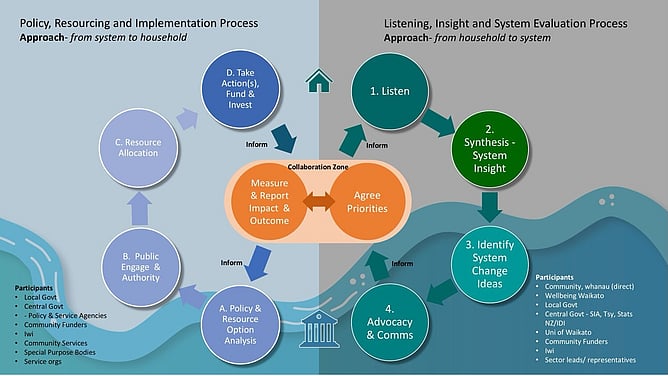
Figure 1. The Wellbeing Ecosystem
On the right-hand side is the Listening, Insight and System Evaluation process. This includes listening, primary research, synthesis, identification of system change ideas, advocacy and communication. This is where there is often an absence of independent information and where the WWP can add most value. WWP is intentionally anchored on the right-hand side.
This positioning reflects both mandate and design. We do not hold statutory authority, control budgets, or deliver services. Those responsibilities sit with local and central government, iwi authorities, funders, and service organisations. They conduct formal policy analysis, exercise authority, allocate resources, and are accountable for implementation outcomes.
Our role is to make sure these processes are as well informed as they could possibly be, by improving the quality, coherence, and system-awareness of decisions made.
On the left-hand side is the Policy, Resourcing and Implementation process. This includes option analysis, public authority, resource allocation, and action.
Between these domains lies the Collaboration Zone, where independent insight intersects with institutional authority and where decision-makers engage with evidence and lived experience.
Our Core Purpose: Household-Level System Insight
WWP exists to strengthen upstream decision-making by grounding it in independent, household-level system insight. Our primary scale of inquiry is the household and whānau. We focus on what it takes for people and families to live lives they value, beginning with whether essential needs are affordable, accessible, and sustainable over time.
WWP is neither an economic think tank nor an economic development agency. We do not design macroeconomic strategy or promote any particular economic model, although we are fully aware of the spectrum of models that are commonly referred to. Our role is practical and grounded. We examine how current system settings affect real households/communities and whether those settings enable material stability, participation, and long-term wellbeing.
Affordability is treated as a system signal. When households experience sustained pressure meeting essential needs, this indicates deeper structural dynamics — costs being pushed downstream, policy settings interacting in unintended ways, or risks accumulating within communities.
Our responsibility is first to understand these realities rigorously through primary research and lived experience. We then synthesise this insight with existing data and analysis, connecting across domains such as housing, income, transport, health, and environmental conditions. This integration reveals patterns and leverage points that are often obscured within institutional silos. In doing so, WWP sets the agenda proactively within the Collaboration Zone. We identify emerging pressures and bring them forward in ways that are clear, coherent, and decision relevant.
What WWP Does — and Does Not Do
As shown on the right-hand side of the diagram, WWP’s work progresses from listening and research through synthesis and system diagnosis to communication and influence.
We conduct high-quality primary research and surface lived experience.
We integrate across silos to build coherent system insight.
We clarify trade-offs and identify leverage points.
We translate that insight to inform upstream decision-making.
We do not design policy instruments, allocate funding, exercise statutory authority, or deliver services. Those functions sit on the left-hand side of the diagram and remain the responsibility of those with democratic, statutory, or fiduciary mandates.
This distinction is deliberate and protective. It clarifies the benefit of WWP’s independence and allows us to integrate across interests without defending programmes, tools, or budgets.
Two Complementary Directions of Design: “Households to System” and “System to Household”
The diagram also highlights a deeper structural distinction in how change occurs within the wellbeing system. On the right-hand side, the direction of inquiry runs from households to system. WWP begins with lived experience, household conditions, and affordability pressures. From there, we move upward — integrating insight, identifying patterns, and diagnosing where system settings may be misaligned. This is a bottom-up direction of analysis. It starts with human experience and asks what must change upstream to improve it.
On the left-hand side, the direction runs from system to household. Policy agencies and funders begin with system-level goals, fiscal constraints, legislative frameworks, and population-wide analysis. From that vantage point, they design policies, allocate resources, and commission services that households and communities then experience or “consume.” This is a top-down direction of design.
Neither direction is inherently superior. Both are necessary.
A system designed only from the top-down risks becoming technocratic, siloed, or disconnected from lived reality. A system informed only from the bottom-up risks lacking coherence, fiscal discipline, or scalability.
In relation to housing affordability, a household-to-system approach begins by understanding how families are experiencing rent increases, transport trade-offs, overcrowding, or energy insecurity. It identifies patterns across communities and surfaces how these pressures interact with income, health, and employment. From there, it asks which upstream settings — planning rules, infrastructure funding, benefit settings, investment incentives — are shaping these realities.
A system-to-household approach begins differently. It examines national housing supply data, fiscal envelopes, regulatory frameworks, and macroeconomic conditions. It then designs policies — zoning reform, subsidies, infrastructure funding, tax settings — that are expected to influence housing outcomes at scale.
Both approaches are legitimate. The strength of the system depends on how well they inform one another. If system-level policy design does not adequately reflect lived household pressures, it risks missing critical friction points. If household-level insight is not translated into scalable system settings, it risks remaining descriptive rather than transformative.
The Collaboration Zone in the diagram is therefore not simply a space of communication. It is where these two directions meet and are reconciled. It is where bottom-up insight and top-down design are aligned into coherent action.
WWP’s role is to ensure that the “households to system” pathway is robust, evidence-based, and influential. Our effectiveness depends on the quality of the integration between these two directions — not on privileging one over the other.
Progress as People- and Nature-Positive
WWP approaches progress as a people- and nature-positive process. Household stability, prosperity, and environmental health are mutually reinforcing. Secure households and communities are better able to plan, invest, and contribute to long-term stewardship. At the same time, environmental degradation erodes the foundations on which durable wellbeing depends.
Innovation, productivity, and better system design expand human capability. When aligned well, they can reduce environmental pressure while improving material stability and access to essentials. The task is not to choose between people and nature, but to ensure that system settings support both.
WWP’s focus is practical. We examine how policy, resource allocation, and institutional design affect households today and whether those settings are strengthening or weakening long-term resilience — for people and for the natural systems on which they depend.
The Collaboration Zone
The Collaboration Zone, positioned at the centre of the diagram, is where WWP’s influence is realised. In this space, independent insight meets institutional authority. WWP strengthens shared understanding across actors, clarifies trade-offs, surfaces blind spots, and improves the framing of decisions.
Accountability for final decisions and implementation remains with those on the left-hand side of the system. WWP is accountable for the integrity, clarity, independence, and usefulness of its insight.
