
An important role of the WWP has been to provide an overview on progress the region is making towards greater wellbeing. In the past we have tracked this against our original wellbeing targets- for example our 2023 Progress Update, as well as providing more specific data and information on wellbeing in relation to areas such as rangatahi wellbeing, food security, housing, the wellbeing of young women, and the wellbeing of people in the Hauraki rohe.
Our 2025 draft State of the Region Report aims to provide a snapshot of wellbeing in the Waikato. The overarching structure of the report is shown below. As well as providing commentary on what we mean by wellbeing, the report also provides a summary of the region’s strengths and challenges, and some of the cross cutting themes that appear to run through all topics and areas.
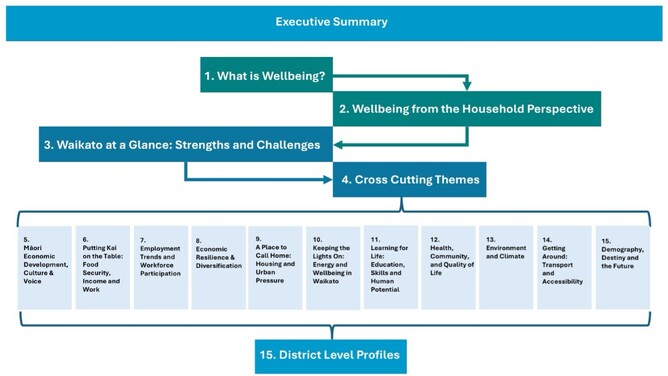
The report has been constructed to look at wellbeing from the household | whānau perspective. This means it explores issues which tend to be most relevant to peoples’ daily lived experiences, and which are also most mentioned by people when asked to rate their own subjective wellbeing. Areas not mentioned in this report are not unimportant for wellbeing, and are addressed in greater detail in other reports such as Waikato Regional Councils Waikato Progress Indicators (WPI). Eleven thematic areas have been selected and are reviewed in the report.
The cross cutting themes which are highlighted in the report are:
1. Income Adequacy and Household Financial Stress: Income growth has not kept pace with rising living costs across the region. Increases in housing, transport, food, and energy expenses have outstripped wage growth for more than a decade, eroding disposable income and straining household budgets. This creates a cascade of wellbeing impacts.
2. Housing → Food Insecurity → Health → Education → Economic Wellbeing: A Causal Chain: Housing is a foundational determinant of wellbeing, shaping multiple downstream outcomes that accumulate across the life course. When housing is unaffordable, unstable, overcrowded, or of poor quality, it creates a cascade of pressures that affect food security, health, education and long-term economic participation.
3. Vulnerability to Extreme Weather → Energy Insecurity → Household Vulnerability
4. Extreme weather events—heavy rainfall, flooding, heatwaves, and cold snaps—expose vulnerabilities in household energy systems and incomes. This vulnerability is a combination of changes in event frequency and intensity, and greater levels of community exposure. Households with limited financial reserves, poor-quality housing, or inefficient appliances are disproportionately affected.
5. Structural Inequities for Māori, Pasifika, Aged and Disabled People. Many wellbeing disparities in the Waikato are rooted in long-standing structural inequities. For Māori, historic land loss, disrupted social structures, and inequitable service systems continue to shape contemporary outcomes. For Pasifika communities, lower incomes, larger household sizes, and limited access to services outside major centres amplify vulnerability. Aged and disabled people face persistent barriers across every wellbeing domain, from transport and housing to digital inclusion and employment.
6. Transport Inaccessibility Reinforcing Housing Displacement. The geography of the Waikato means that transport and housing pressures are deeply intertwined. As housing costs rise in Hamilton and nearby centres, lower-income households are pushed further outward into districts with cheaper rents or home-ownership opportunities.
A report like this will never be complete and will always miss things that are important to people, whānau and communities. Tell us what you think- we’re keen to hear what you found most useful, if there is data or commentary you’d like to see amended, or if there are important things you think are missing.
